


Welcome to the Official
Timeline of Columbia
This is a documented history of 'Columbia' the COUNTRY, and as a female spiritual embodiment of the United States of North America (aka later known as Miss Columbia, Lady Columbia, Lady Liberty). Here you'll find the most complete, and organized, scope of Columbia available, from the first mention of the term, to our current year. We've included appearances in presidential correspondence, key political legislation, scientific data, artist's illustrated depictions, poems, collections of written music, minted coins, sculptures, namesakes and much more.
Using the facts in the timeline we can learn more about Columbia's origin, ethical and political characteristics, her various iterations, and physical locations around our nation.
In the New WORLD ... Ideas of a New Land ... a New HEAVEN on Earth
In Need of a New NAME ...
First Mention of "Columbina" (later "Columbia")
1697
Phaenomena Quaedam Apocalyptica
Written by; Samuel Sewall


Above
Print Ad (1697)
Left
Portrait of Samuel Sewall (1652 – 1730),
Artist: John Smibert (1688 – 1751),
Oil on canvas, circa 1729.
In 1885, these writings are referenced at the Massachusetts Historical Society discussing naming the country Columbina. with the President. See 1885.
For more on Samuel Sewall, and some of his writings, please click here.
A collection of writings were published in 1697, with this lengthy title: "Phenomena Quaedam Apocalyptica ... or some few lines toward a description of the New HEAVEN as it makes to those who stand upon the NEW EARTH” by Samuel Sewall of the Province of Massachusetts Bay.
Notably, Sewall, who was a prominent printer, businessman, and judge, would later, in 1700, pen the first published attack on slavery in the New World, titled ‘The Selling of Joseph’. While he had previously been appointed as one of the nine judges during the height of the Salem witch trials, he later regretted his role and gave a public apology –being the only judge involved in the trials to do so. To the Left is an ad promoting the writings.
In this work, he describes the ‘NEW WORLD’–specifically, the portion of the Americas under England’s control, also known as ‘New England’ or ‘British America’- as ‘Columbina.’ This is found in the 2nd entry of the collection titled: “To the Honorable William Stoughton, Esq. Lieut. Governour, and Commander in Chief, in and over His Majesties Province of the Massachusetts Bay in New-England’, and marks one of the first acknowledgements that what is now known as the ‘United States’ was being referred to as Columbina, and increasingly through the1700s, as ‘Columbia’ throughout both the ‘New’World, as well as the ‘Old’.
"And I humbly crave leave to enter a Claim; that the New-World may be no longer made an Outcast: but may be admitted to assist at the coronation. Perhaps some may think it superfluous, at this time of day to publish any thing against those Conjectures which, being groundless, fall of themselves. But on the other hand, when the Great KING was by his Ambassadors keeping up a Treaty of Marriage with America: it was then very Unseasonable and absurd to raise, or receive a Vain Report to her Disparagement. And it seemeth convenient, that that which hath been said and written, and printed over and over again, to the Injury and Prejudice of Columbina: should one time or other be Unsaid; that so the Scandal may be removed. And seeing the meer Conjectures of Learned and Great Men, do bear, a great sway with multitudes, who never enquire what the grounds are they go upon: it may seem a just Occasion for this small disquisition. In which I have endeavoured to prove that America’s Name is to be seen fairly Recorded in the Scriptures..."
"Columbia" is used in Reference to the Territories Known as British America in the World's First "Magazine" :
The Gentleman's Magazine of London
1738
Excerpt from the debates in Parliament;
"...It is observable that their conquests and acquisitions in Columbia (which is the Lilliputian name for the country that answers our America,) have very little contributed to the power of those nations..."
The first known use of Columbia as personification of America appeared in a weekly British publication in 1738. This pre-Revolutionary War magazine had a wide range of varied content including; news of the day, political reports, literary items, and other unusual tidbits. This was also the first periodical to use the term, "magazine" in its title, having begun in 1731 and lasting until 1907.
The original issues had "Debates in the Senate of Magna Lilliputia". Since publication of Parliamentary debates was illegal, they were issued under the thin guise of, "Reports of the Debates of the Senate of Lilliput" or similar headings, with fictitious names used for most individuals & places. Of great significance in this issue is the very first use of the term "Columbia" to refer to today's "America".


"Columbia's Many-Peopled Bowery Groves ..."
Famous English Poet, Aaron Hill, References in
"Free Thoughts Upon Faith: or the Religion of Reason"
1746
Excerpt from the poem;
"Columbia's many-peopled bow'ry groves, Fanning, in feath'ry pomp, her tawny tribes, From the sun's down-driv'n ray ..."

Aaron Hill (1685–1750),
Born In London,
English Dramatist and Writer
Portrait Artist:
by Henry Hulsbergh (Hulsberg)
Line Engraving, 1709
NPG D35830

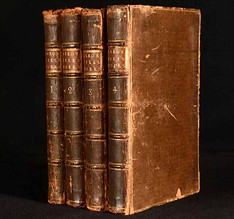
4 Volume Collection of Aaron Hill writings, including;
Poem; Free Thoughts Upon Faith: or, the Religion of Reason.
Published by: J. Osborn, London, 1746.
For more on other Aaron Hill works, please visit;
https://www.grubstreetproject.net/people/254/works/

Liberty - with her Liberty Pole and Cap - Depicted in England and Other European Countries as Ideas of the Enlightenment Spread
1753
"Oh! Liberty do thou inspire our Souls,
And make our lives in thy possession happy;
Or our Deathe Glorious, in thy just defense!"
Here in the London Magazine, we see Liberty personified as a woman, holding her iconic Liberty Pole and Liberty Cap, with who appears to be Britannia, the allegorical representation of Great Britain.
During the period called the "Age of Enlightenment", the idea of "Liberty" expanded from simply referring to the manumission (freeing) of an (individual) slave from their immediate "master", to one that applied to wider groups within society and included the freedom from absolute rule and power of a supreme king/ruler. While it was not "liberty" for all, these ideas would later help to form the foundation for the new nation known as "Columbia".

Artist: Anthony Walker
Medium: Printed Engraving
Publisher: London Magazine
" COLUMBIA! View Thy Prince ... "
Harvard College Poems are Written to England with Sympathy on the Death of King George II and Congratulations to King George III on his Coronation
1761
"...Behold Britannia! in thy favour'd isle, at distance, thou, Columbia! view thy prince' ..."
Portrait of King George III
(17xx-1820) circa 1763.
George III was King of Great Britain and Ireland from October 25, 1760 until his death in 1820.


"Unrivaled in COLUMBIA" ... The Lamentation of Harvard.
A Poem on the Destruction of Harvard Hall in the Massachusetts Gazette.
1764


Harvard Hall, our COUNTRY's Largest Library & Collection of Scientific Instruments, is Destroyed by Fire ...
The name COLUMBIA continues to find a more prominent role in the identity of the British Colonies of North America ...
"...Why could ye not, the fam’d Museum spare, Unrival’d in Columbia, where my sons ..."


Original Sketch of Harvard Logo, 1643
Modern day Harvard logo, shield adopted in 1843


Liberty Begins to Take Center Stage
in the Discontented Colonies of "British America"
appearing as Paul Revere's Masthead for the "Boston Gazette"
1770
"BRITISH AMERICANS", as we were then known, increasingly assert that their rights are not being respected by Parliament and the Crown.
Paul Revere produces a new masthead for The Boston Gazette, first published on January 1st, 1770, that depicts Britannia, seated with the shield of the United Kingdom nearby, but also holding a LIBERTY POLE and CAP as well. Britannia releases a DOVE of PEACE from its cage.
It is important to understand that at this time, while the name COLUMBIA had been used to refer to this NEW LAND in the NEW WORLD, the "Sons of Liberty" were primarily arguing for their rights as British subjects. As tensions progressed, these same "Sons of Liberty" and many colonists, began to imagine a full separation and independence from England.
This was the time in which COLUMBIA as a distinct and INDEPENDENT NATION were cultivated.


Artist: Paul Revere
Medium: Wood/Lead Engraving
Publisher: Isaiah Thomas (Boston)

Portrait of Paul Revere highlights his work as a silversmith. Artist John Singleton Copley, 1768. Museum of Fine Arts Boston
Liberty Boldly Sits with Liberty Pole and Cap
on Paul Revere's Masthead for 'The Massachusetts Spy"
1771
LIBERTY Sheds the Identity of Britannia and Rests Alone without any Iconography of the "Mother Country", England.
"Likely created prior, but printed in 1771 as an illustrated masthead which features the text 'The Massachusetts Spy' in the center, heavily decorated with flourishes and scrolls. To the left and right are two medallion shaped illustrations both with Chippendale-style mantling. To the left is an allegorical figure of a woman, Liberty, holding a liberty pole with cap. She is leaning against a pedestal and a rolled copy of the Spy. To the right in an additional illustration featuring two nude, kneeling figures who are removing flowers from a central basket. Beneath them on a ribbon scroll is the text “They cull the choicest."


Detail of Liberty
Artist: Paul Revere
Medium: Wood/Lead Engraving
Publisher: Isaiah Thomas (Boston)
1774
Female writer, Mercy Otis Warren, uses "Columbia" when referring to the country, in her poem "Political Reverie".
Mercy Otis Warren should be called, "The Mother of our Country", but for now, let's reflect on an earlier work.
Mercy is a writer of multiple plays, and articles, creating an awareness of the need to limit big government and to ensure the rights of the people. Here we focus on one of her earlier poems, "Political Reverie" (Shown) as significant because she refers to the U.S. territory as "Columbia". One of the first recorded, demonstrating the population understood and recognized the term.
She was closely involved with the 'Sons of Liberty', meetings were held at her home. She was as much in the “Patriot” Revolutionary movement as any of the founding fathers. Decades later it would be discovered that her writing, of the 1788 pamphlet, “Observations on the New Constitution” would become the primary reason the Bill of Rights was added to the US Constitution.

Portrait of Mercy Otis Warren (1728-1814),
Artist: John Singleton Copley (1738–1815),
Oil on canvas, circa 1763.

1775
The Revolution in British America Begins!

The Battles of Lexington & Concord
kick off what would become the Greatest Revolution in Human History and Establish the Greatest Republic and Nation the World has Ever Known ...
"COLUMBIA"
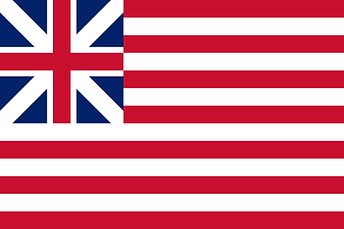
But as evidence of the continued hopes for reconciliation with the "Mother Country", England, is the design of our first flag as the "United Colonies."
This flag included the Union Jack of the United Kingdom, but simply added 13 stripes to the design. This flag remained our official flag from 1775, through our publishing the Declaration of Independence in 1776, and until 1777 when the Continental Congress adopted a flag with 13 stars and 13 stripes.
1775
Freed slave, Phyllis Wheatley, pens poem in letter to George Washington. Dated material documenting Columbia as a female embodiment of our nation.
Enclosure (aka “To His Excellency, General Washington”).
Poem by Phillis Wheatley,
October 26, 1775
Excerpt:
Celestial choir! Enthron’d in realms of light,
Columbia’s scenes of glorious toils I write. While freedom’s cause her anxious breast alarms, She flashes dreadful in refulgent arms.
See mother earth her offspring’s fate bemoan,
And nations gaze at scenes before unknown!
See the bright beams of heaven’s revolving light
Involved in sorrows and the veil of night!
The goddess comes, she moves divinely fair,
Olive and laurel binds her golden hair:
Wherever shines this native of the skies, Unnumber’d charms and recent graces rise.
Muse! bow propitious while my pen relates
How pour her armies through a thousand gates:
As when Eolus heaven’s fair face deforms, Enwrapp’d in tempest and a night of storms;
Astonish’d ocean feels the wild uproar,
The refluent surges beat the sounding shore;
Or thick as leaves in Autumn’s golden reign,
Such, and so many, moves the warrior’s train.
In bright array they seek the work of war,
Where high unfurl’d the ensign waves in air.
Shall I to Washington their praise recite?
Enough thou know’st them in the fields of fight.
Thee, first in place and honours,—we demand
The grace and glory of thy martial band.
Fam’d for thy valour, for thy virtues more,
Hear every tongue thy guardian aid implore!
One century scarce perform’d its destined round,
When Gallic powers Columbia’s fury found;
And so may you, whoever dares disgrace
The land of freedom’s heaven-defended race!
Fix’d are the eyes of nations on the scales,
For in their hopes Columbia’s arm prevails.
Anon Britannia droops the pensive head,
While round increase the rising hills of dead.
Ah! cruel blindness to Columbia’s state!
Lament thy thirst of boundless power too late.
Proceed, great chief, with virtue on thy side,
Thy ev’ry action let the goddess guide.
A crown, a mansion, and a throne that shine,
With gold unfading, Washington! be thine.
African born Phillis Wheatley was captured when she was 8 years old and sold to the Wheatley family in Boston. Educated by her owners, she proved to be a very talented writer. She would become published in England. Notes confirm she was a woman of unmixed African ancestry. Wheatley was freed as an adult. In this volume she discusses her African background and her love of Freedom in poetry.

1776
George Washington pens letter back to Phillis Wheatley in appreciation of her poem, "Enclosure".

to Phillis Wheatley
”Founders Online, National Archives;https://founders.archives.gov/documents/Washington/03-03-02-0281
[Original source: The Papers of GeorgeWashington, Revolutionary War Series, vol. 3,1 January1776–31 March 1776, ed. Philander D. Chase.Charlottesville: University Press of Virginia, 1988, p. 387.]
Mrs Phillis,
Your favour of the 26th of October did not reach my hands ’till the middle of December. Time enough, you will say, to have given an answer ere this. Granted. But a variety of important occurrences, continually interposing to distract the mind and withdraw the attention, I hope will apologize for the delay, and plead my excuse for the seeming, but not real, neglect. I thank you most sincerely for your polite notice of me, in the elegant Lines you enclosed; and however undeserving I maybe of such encomium and panegyrick, the style and manner exhibit a striking proof of your great poetical Talents. In honour of which, and as a tribute justly due to you, I would have published the Poem, had I not been apprehensive, that, while I only meant to give the World this new instance of your genius, I might have incurred the imputation of Vanity. This, and nothing else, determined me not to give it place in the public Prints. If you should ever come to Cambridge, or near Head Quarters, I shall be happy to see a person so favour'd by the Muses, and to whom nature has been so liberal and beneficent in her dispensations. I am, with great Respect, Your obedt humble servant,
- G. Washington
Cambridge February 28th 1776
1776
Columbia Triumphant (Song).
Citizens of the U.S. referenced as "Columbians".
THAT Power, who form’d the unmeasured seas,
Not with fictitious trident sways, Look’d from the empyrean sky: The solid land, the extended main, Which all their ample realms contain, 5
Lie naked to his eye.Fierce Discord show’d the earth, the seasInvolved in one promiscuous blaze, While doubling thunders roar’d. “Michael! go forth,” the Godhead cried, 10
“Wave my dread ensign o’er the tide, And edge Columbia’s sword!” The angel wing’d the ethereal road, To obey the mandate of his God, And reach’d Columbia’s shores. 15
He saw her striplings on the wave Proud Albion’s boasted navy brave, And battle all her powers. In vain her thousand ships appear, In all the horrid pomp of war, 20
And thunder round the coast. Whole squadrons captive led he view’d, By force inferior far subdued, Their wealth, fame, glory lost! Amazed, the seraph seeks the sky, 25
And tells the wondrous tale on high; All heaven astonish’d gaze! Thrones, angels, principalities,In loud applause united raise A universal praise. 30
“Hail, brave Columbians! sons of Heaven! To whose all-conquering arm ’tis given o bend proud tyrants down! To burst vile Slavery’s iron band, Guard sacred Freedom, save your land, 35
And crack the lion’s crown. ”They ceased—when thus the Almighty spoke; —Heaven’s adamantine pillars shook, As the dread word went down. “Columbia’s sons, I give to reign 40
At home, and o’er the boundless mainTo have an equal crown!” Freemen! perform this glorious trust! Britannia’s brazen fetters burst! Her towering pride subdue! 45
Henceforth, my sons, not only sway The continent, but on the sea, Go! curb proud Albion too!
William McCarty in 1776
McCarty, William, ed. The American National Song-Book: Songs, Odes, and Other Poems, on National Subjects. Philadelphia: Published by Wm. McCarty, 1842; Bartleby.com, 2013. https://www.bartleby.com/lit-hub/the-american-national-song-book/16345-2/
1781
Libertas Americana Silver Medal
was made to commemorate the American Revolution.
The Libertas Americana was a medal made to commemorate the American Revolution. It was designed in part by Benjamin Franklin.
The medal was originally conceived by Benjamin Franklin after being asked to create a monument in honor of the 'Siege of Yorktown'. Franklin outlined his idea in a letter to Robert Livingston on 4th of March, 1782. The reverse design was further developed by Esprit-Antoine Gibelin and Augustin Dupré. The obverse of the medal features the goddess Liberty. Behind her is a pole adorned with a Phrygian (Liberty) cap. The reverse features the infant Hercules representing the United States being attacked by a lion, representing the United Kingdom. The infant, who is shown strangling two snakes, is being protected by Athena who represents France. The reverse includes the motto, "NON SINE DIIS ANIMOSUS INFANS", from Horace's ode "Descende coelo", which translates to "The infant is not bold without the aide of the gods."

1784
After the Revolutionary War is Officially Over, the NEW World stands Triumphant Over the OLD World ... It's Time for a NEW Name ...
"King's College be forever hereafter called and known by the name of COLUMBIA College."
To fully understand the history of Columbia University, we first have to know its roots began as King's College in New York City. King's was created in 1754 by a Royal charter from King George II as an Anglican college, headed by the Church of England. It used 6 acres granted from Trinity Church's current land. At its founding, it was the only college in New York.
In 1760, King's College moved to its own building at Park Place. The name "King's" remained until the revolutionary war ended. For 8 years during the war classes were suspended and the university was used as hospital and military quarters for both the Americans and the British. It wasn't until 1784 that the College turned to the state for help. The Legislature agreed to assist the college, and on May 1, 1784, it passed "an Act for granting certain privileges to the College heretofore called King's College". Finally, in an effort to demonstrate its support for the new Republic, the N.Y. Legislature stipulated that "the College within the City of New York heretofore called King's College be forever hereafter called and known by the name of Columbia College.
For more on the history of Columbia College, visit: https://en.wikipedia.org/wiki/History_of_Columbia_University

Artist: Charles Havens Hunt
c1881, Wood Block Print

June 3, 1755, the Governors of the College adopted a design prepared by Dr. Johnson for the seal of King's College, which continues to be that of Columbia College with the alteration in name.

Artist: Unknown
c1790
1787
The UNMAPPED Northwest Territory of North America...
Original map of the United States 1787c, Amerique Septentrionale, shows the Northwest Region was largely unexplored with no claims, or names, in the area.


See Voyage of Columbia, 1791-1792.
... WHICH Country will win the RACE to "Lay Claim" to this Territory? ...
1787
'Ye Daughters of Columbia Your Country Calls'...
Future PRESIDENT John Quincy Adams, Son of (also) Future President John Adams, Gives His Harvard Graduation Speech,
Excerpt from
- An Oration. Upon the importance and necessity of public faith, to the well-being of a Community.
Wednesday, July 18, 1787
At about 11 o’clock the procession began from the door of Harvard. The succeeding Classes went before us; and wepreceded the President and fellows of the University, who, were follow’d by the governor and council of the Commonwealth:the company of light horse, headed by Coll. Swan, were drawn up before the meeting house. As soon as we all got placed, the president (John Quincy) opened the Ceremony by prayer: the performances then were delivered, in the order, in which they are mentioned, except that Cranch spoke an Oration instead of a forensic. When it came to my turn to speak I delivered the following piece...

John Adams,
1735-1826

John Quincy Adams,
1765-1848
"... In this country, I am persuaded there yet exists a spark of patriotism, which may still rekindle a vivid flame. On you, ye lovely daughters of Columbia, your country calls to revive the drooping public spirit: Without recurring to the examples of distant ages, let me only recommend to you, to imitate yourselves: you have already given ample proofs that the patriotic virtues, are not confined to man: Nature it is true, has not formed you, to tread the paths of active life: but your’s is the nobler influence of the mind: tis your’s to encourage with the smiles of applause every virtuous undertaking, and when the warrior returns from the field of battle with the laurel in his hand, ’tis your’s to twine it round his head. Oh! may you every instill into the tender mind the principles of liberty and of patriotism; and remember that the man who can violate his country’s faith, must ever be regardless of his own..."

An American statesman, attorney, diplomat, writer, and Founding Father who served as the second president of the United States from 1797 to 1801
An American statesman, politician, diplomat, lawyer, and diarist who served as the sixth president of the United States, from 1825 to 1829.
1787
The "COLUMBIA" and The "WASHINGTON" Set Sail ! ...
To Lay Claim to New Territory for Their New Country : COLUMBIA
The First of Many Times the Name of the Nation & this Founding Father Will Be Paired ...
The ships (Columbia & Washington) first set sail towards the Northwest coast in 1787, John Kendrick and Robert Gray were Captains of the two ships.
1789 - The Columbia becomes the first U.S. Ship to circumnavigate the globe, with Captain Robert Gray leading the expedition.


John Kendrick,
1740-1794
Robert Gray
1755 – c. July 1806

For more on Robert Gray see Voyage of Columbia, 1791-1792.
Original Painting of the (2) ships were created as oil on glass (Reverse), Circa 1800 (Artist Unknown).
Rights: Hong Kong Maritime Museum
1787
'Columbia and Washington' Silver Medal
1st Official coin produced for use in trade on Ken/Gray’s Voyage to mark their presence & establish claim on territory. One side of the coin shows the ships, the "Columbia", and the "Washington".


1788
Mercy Otis Warren anonymously publishes pamphlet which initiates the inclusion of the Bill of Rights in the ratification of the Constitution
Mercy Otis Warren
Pseudonym, "Columbian Patriot".
The Constitution of the United States was first drafted in 1787, its content was not without controversy among citizens of the newly formed country. There was a debate in the country over the ratification of the constitution, dividing the new nation into federalist (those who supported ratification) and anti-federalist camps...
The anonymously published pamphlet, Observations on the new Constitution : and on the federal and state conventions shared common criticisms made by anti-federalists regarding the new constitution. The author of this anti-federalist pamphlet, along with other anti-federalist writers, ultimately lost the war against ratification, but the anti-federalists won the battle for the inclusion of a Bill of Rights in the U.S. Constitution.
What anti-federalists were not aware of was that the author of “Observations on the new Constitution” was a woman. Originally attributed to Elbridge Gerry, the true identity of the author of the pamphlet remained hidden for over a century. It was not until lawyer, and historian, Charles Warren uncovered evidence that his ancestor, Mercy Otis Warren (Columbian Patriot), had written the anti-federalist pamphlet, that historians began to properly credit her contribution to the argument for the inclusion of the Bill of Rights in the U.S.Constitution
Full article, Mercy Otis Warren: The Secret Muse of the Bill of Rights, written as Guest Post by Danielle Herring, an intern with the Digital Resources Division of the Law Library of Congress.
https://blogs.loc.gov/law/2022/12/mercy-otis-warren-the-secret-muse-of-the-bill-of-rights/

Portrait of Mercy Otis Warren (1728-1814),
Artist: John Singleton Copley (1738–1815),
Oil on canvas, circa 1763.
See also 1774 for other great contributions from Mercy Otis Warren and 1931 finally recognized for her contributions.
More on Mercy Otis Warren
1788
Wright's Ferry Pennsylvania Renames Itself Columbia
(In hopes of becoming location of U.S. capital)
Formerly Wright's Ferry, Columbia is a borough (town) in Lancaster County, Pennsylvania, United States. As of the 2020 census, it had a population of 10,222. It is 28 miles (45 km) southeast of Harrisburg, on the east (left) bank of the Susquehanna River, across from Wrightsville and York County and just south of U.S. Route 30. The settlement was founded in 1726 by Colonial English Quakers from Chester County, led by entrepreneur and evangelist John Wright. Establishment of the eponymous Wright's Ferry, the first commercial Susquehanna crossing in the region, inflamed territorial conflict with neighboring Maryland but brought growth and prosperity to the small town, which was just a few votes shy of becoming the new United States' capital. Though besieged for a short while by Civil War destruction, Columbia remained a lively center of transport and industry throughout the 19th century, onceserving as a terminus of the Pennsylvania Canal. Later, however, the Great Depression and 20th-century changes in economy and technology sent the borough into decline.
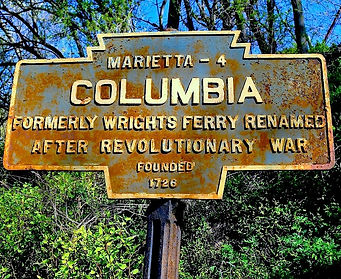
Photo Credit: Columbian Spy
https://columbiaspy.com/2013/02/02/mountville-replacing-historical-markers-lancasteronline/

1789
Proposal of Government Seat
(To name location of nation's capital)
An act to establish the seat of government of the United States ... 1789, September the 22d. New York, printed by Thomas Greenleaf. [1789].
The location was said to be Washington's original preferred location, however, it fails by lack of 1 vote and is later moved in what's known as the Compromise of 1790.

1790
The Residence Act - Act of Congress for Establishment of Territory of Columbia - (Compromise).
The Residence Act, officially titled "An Act for Establishing the Temporary and Permanent Seat of the Government of the United States," was passed on July 16, 1790, and it selected a site on the Potomac River as the permanent capital (Washington, District of Columbia), in ten years time. Also, this act designated Philadelphia as the temporary capital for a period of ten years. The Residence Act was the result of a compromise reached between Thomas Jefferson, Alexander Hamilton and James Madison concerning the permanent location of the Federal capital. In exchange for locating the new capital on the Potomac River, Madison agreed not to block legislation mandating the assumption of the states' debts by the Federal government.
See also song titled, "The Room Where It Happened" in the musical play, Hamilton, referencing the Compromise of 1790.

1790-1793
'Voyage of the Columbia' Sets Sail to Explore and Claim Territory in Northwest U.S.
In 1790, Captain Gray set out on the Columbia again for the Northwest Pacific Coast, this time, holding papers from President Washington, for the purposes of claiming territory for the country.
In 1792, (April) Capt Gray met w Capt Vancouver (or at least his reps) to mention the river he imagined was there, but most didn’t think existed
In 1792, (May) Captain Gray entered through the mouth of the Great River of the West, which he named after the country to claim it for the nation. This discovery, and naming for the nation, was the primary source of our “claims” to the Oregon Territory vs the other powerful nations of the world in future decades (England, Spain, & Russia)
1792 - First hand ship log account of Captain Robert Gray's Discovery - 'I landed w Capt. Gray TO TAKE POSSESSION'.
in 1793, The Columbia returns home to Boston.

Robert Gray
1755 – c. July 1806
1792
Map - Planned Location for Establishment of Territory of Columbia
(District of Columbia)
[Boston,1792]
Headings
- Washington (D.C.)--Maps--Early works up to 1800
- United States--District of Columbia--Washington
Notes
Shows block numbers and proposed government buildings.
Watermarks:
J Whatman, Budgen, [crown over fleur-de-lis].
Includes text and notes.
Soiled, torn, and annotated in ink at upper right: This map is one of the original impressions from the "Boston Plate" of 1792 ... Hugh J. Taggart.
Repository
Library of Congress Geography and Map Division Washington, D.C. 20540-4650 USA dcu

"Plan of the city of Washington in the territory of Columbia: ceded by the states of Virginia and Maryland to the United States of America, and by them established as the seat of their government, after the year MDCCC"

1792
Liberty Displaying the Arts and Sciences, aka,
The Genius of America Encouraging the Emancipation of the Blacks
An oil-on-canvas painting by the American artist Samuel Jennings. Held in the permanent collection of the Library Company of Philadelphia, this work is the earliest known American painting promoting abolitionism in the United States.
The Library Company of Philadelphia, commissioned Jennings (an ex-Philadelphian relocated to London) to create a work depicting "the figure of Liberty (with her cap and proper Insignia) displaying the arts" as a representation of slavery and a symbol of the abolitionist movement. The library records the painting as having been given to it by the artist in March 1792, shortly after its completion in London.
Jennings completed two versions of the painting, both virtually identical save for size and composition. The larger version is oil on canvas while the smaller and lesser known version is oil on linen and held by Winterthur Museum, Garden and Library. The other major difference is that the smaller painting features the Union Jack on a shield among the symbolic objects surrounding the figure of Liberty. The smaller version was intended to serve as the basis for prints (never produced) meant for sale in Britain. The work is the earliest known anti-slavery painting by an American artist and reflect increasingly abolitionist sympathies of Philadelphia's Quaker leaders and institutions.

Jennings's allegory shows a blond, white personification of Liberty, or according to the full title, personification of America wearing a white gown and with a liberty cap atop a pike or spear. She places books (the catalog of the Library Company, and two others, labeled "philosophy" and "agriculture") on top of a pedestal. Looking on is a group of two black men, a woman, and a child (freed slaves), whose comparatively diminutive size and clasped hands, bows, and other gestures evoke humility and gratitude.[5][6]
Surrounding the five figures, in the foreground, are various symbols of knowledge and learning: a bust (possibly of Henry Thornton), a scroll (labeled "geometry"), a paper sketch of columns (architecture); a globe (geography), a lyre and sheet music (music), and a paper with escutcheons on it (history and heraldry). In the background, freed slaves are dancing and celebrating around a liberty pole as one plays the banjo; behind them are ships (symbolizing commerce) on a body of water.[2]
1792
Engraving of Liberty, aka Columbia, being presented a proposal for the advancement of women's rights.


Detail showing, "Rights of Women"
Title: The Genius of the Ladies Magazine, accompanied by the Genius of Emulation, who carries in her hand a laurel crown, approaches Liberty, and kneeeling, presents her with a copy of the Rights of Women.
Date Published: 1792
Published: Philadelphia
Medium: engraving.
With restrictions imposed on their American citizenship, white women worked to expand their rights to education in the new nation using literature and the arts.
The first journal for women in the United States, The Lady’s Magazine and repository of entertaining knowledge, introduced their initial volume with an engraving celebrating the transatlantic exchange between women’s rights advocates.
In the engraving, English writer Mary Wollstonecraft presents her work, “A Vindication of the Rights of Woman,” to Liberty (aka Columbia) who has the tools of the arts at her feet.
1793
Hail Columbia! Columbia Hail!
Independence Day (1793) Celebration Song
Sung at Elizabeth-Town N.J. at the Celebration of Independence, July 4, 1793.
Written to the tune of “Rule Britannia”.
“When exiled Freedom, forced to roam,
Sought refuge on Columbia’s shores
The lovely wanderer found a home,
And this the Day that made Her ours."
Chorus:
“Hail Columbia! Columbia Hail!
To Thee the praise is due that MAN IS FREE!"

1795
Oil Painting of "Lady Liberty" (aka Columbia) with Eagle, Liberty Pole, Liberty Cap and more.

Lady Liberty (aka Columbia) shown with common objects used to identify her; Eagle, Liberty Pole, Liberty Cap, and U.S. Flag on Shield, set within an oval vignette on a brown ground with gilt highlights at each corner.
18th Century
Artist: Unknown
Medium:
Oil on panel, 7.5" x 8.5"
Unframed.
1796
Liberty.
In the Form of the Goddess of Youth, Giving Support to the Bald Eagle
Title: Liberty. In the form of the goddess of youth, giving support to the bald eagle
Artist: Edward Savage (1761-1817), Engraver
Published: Philadelphia
An allegory of American liberty. Liberty (aka Columbia), represented by a maiden in the form of the goddess Hebe, offers a cup to an eagle descending from the upper left. With her right foot she treads on chains, a scepter, a key, and other implements of tyranny. At the lower right, beyond a pedestal or altar, the town of Boston is visible, with lightning in the sky overhead.

1798
"Hail COLUMBIA!" - Our ORIGINAL National Anthem
Is Born in Philadelphia
First performed (in the then capital of the united States) –at Philadelphia’s New Theatre–April 25th. After this opening night the song becomes a hit and word spreads. Days later, letters are written, to and from, Abigail Adams (Wife to President John Adams), President Washington, and other highly recognizable people with reference to its patriotic appeal. The song then serves as de-facto national anthem of the United States until 1890's (See Military Song).

May 9th, Letter from Joseph Hopkinson to George Washington.
https://founders.archives.gov/documents/Washington/06-02-02-0191
May 27th, Letter from George Washington to Joseph Hopkinson.
https://founders.archives.gov/documents/Washington/06-02-02-0227


Joseph Hopkinson (1770–1842), the son of Francis Hopkinson, was a graduate of the University of Pennsylvania in 1786 and was married to Emily Mifflin, daughter of Thomas Mifflin. A distinguished lawyer, Hopkinson was a member of Congress for three terms beginning in 1814 and a federal judge from 1828 until his death.* He is best known as the author of the patriotic anthem, “Hail Columbia” (DAB).
1799
New Testament, Bible Translated for
"The United States of Columbia"
Published and Sold By: Isaiah Thomas and Andrews.
Printed: Worcester, Mass, 1791-1799

Close up abstract of title page shows, "United States of Columbia" as common knowledge name of United States.

